
Digital Dollars for Agricultural Exporters: How to Manage Excess ARS Liquidity and Reduce Peso Exposure
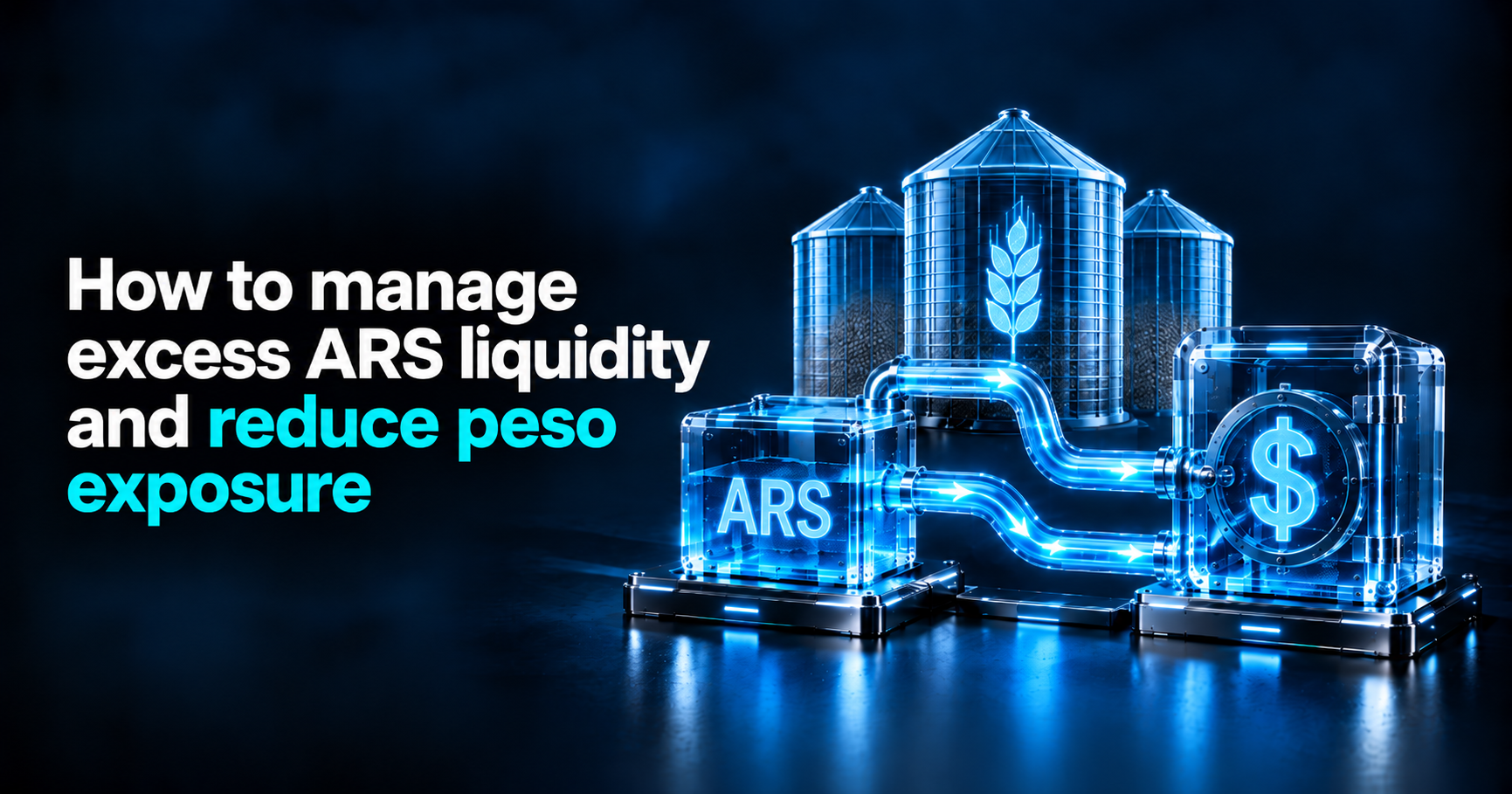
An agricultural exporter may need ARS to run its local operations without needing all of those pesos today.
After converting part of its liquidity to cover transportation, payroll, taxes, services, or local suppliers, the company may still be left with a portion of its ARS balance that has no immediate use.
That creates the next decision for the finance team: how much of that liquidity needs to remain in pesos, and how much could be managed differently until it is needed again?
In September 2026, Argentina’s Consumer Price Index rose 1.9% month over month, according to INDEC. For a company holding liquidity for weeks or months before putting it to work, the length of time those funds remain exposed to ARS also becomes part of the treasury decision.
Digital Dollars, meaning stablecoins linked to the US dollar, offer another way to manage that portion of excess liquidity without converting the entire treasury balance or giving up the pesos the business still needs for local operations.
When your ARS balance exceeds your immediate needs
Pesos are still essential for operating in Argentina. But not every part of a company’s liquidity has the same time horizon.
Some funds may be earmarked for immediate obligations. Others may be needed for expenses later on. And another portion may remain temporarily available with no immediate use.
For the finance team, the question is no longer simply how much ARS the company holds.
It becomes: how much do we need to keep in pesos for day-to-day operations, and how much is genuinely temporary excess liquidity?
That distinction matters because holding excess liquidity in ARS is itself a treasury decision. A balance the company needs this week does not serve the same purpose as funds it expects to use later.
This is part of a broader challenge: as agricultural exporters operate across more markets, currencies, and international financial flows, treasury management becomes more complex as well.
What Digital Dollars mean for a business
When we refer to Digital Dollars, we mean stablecoins linked to the US dollar.
They are designed to track the value of USD. They are not the same as holding dollars in a bank account and come with their own risks, so their use should be assessed within the company’s broader financial policy.
In this context, their role is very specific: to manage a portion of corporate liquidity in a USD-linked unit when those funds do not need to remain in ARS in the short term.
The YouHodler use case is built around exactly that logic: identify excess liquidity in pesos, convert some or all of it into Digital Dollars, and keep those funds available for future business needs.
What Digital Dollars can add to an agricultural exporter’s treasury strategy
The value is not simply in exchanging one currency for another. It is in allocating liquidity according to the role it needs to play within the business.
Reduce exposure to the peso
Once the company has set aside the ARS it needs for local operations, the remaining excess liquidity can be held in Digital Dollars linked to USD.
This allows the business to reduce its exposure to ARS specifically on the funds it does not need to keep in pesos at that moment.
Better preserve the value of excess liquidity
When funds are not going to be used immediately, the amount of time they remain in treasury matters.
Holding part of the excess balance in Digital Dollars allows that liquidity to remain linked to USD while it waits for its next use, rather than leaving the entire amount exposed to the peso.
This does not remove the risks associated with stablecoins or guarantee a particular outcome. The purpose is to reduce ARS exposure for a specific portion of the treasury balance.
Maintain operational flexibility
Managing excess liquidity does not have to mean locking it away.
Funds can remain available and, as the company’s needs change, be held, converted again, or used for other supported transactions.
This gives the finance team more flexibility to adapt treasury decisions to the business rather than committing all available liquidity to a single use from the outset.
Prepare for future payments
Some of the liquidity the company does not need today may already be associated with obligations that will arise later.
For an agricultural exporter working with international suppliers, services, technology, machinery, or other cross-border requirements, preparing that liquidity in advance can help connect today’s treasury position with tomorrow’s payments.
Use balances for international transactions
Digital Dollar or Digital Euro balances can also be used for certain international transactions, depending on the specific transaction, jurisdiction, and supported flow.
For a company managing both domestic expenses and international obligations, this means the same liquidity can remain useful when the next business need is no longer denominated in ARS.
These five benefits are part of the treasury use case YouHodler has defined for Argentine companies: reducing peso exposure, better preserving liquidity value, maintaining operational flexibility, preparing for future payments, and using balances in international transactions.
This does not mean dollarizing the entire treasury. In fact, the starting point is the opposite: identify which part of the balance genuinely needs to remain in ARS and manage only the excess differently.
The decision is not ARS or USD for the entire business
An agricultural exporter still needs pesos for payroll, taxes, transportation, services, and local suppliers.
Managing excess liquidity with Digital Dollars therefore does not mean replacing ARS in the company’s day-to-day operations.
It means recognizing that not all liquidity serves the same purpose or needs to remain in the same currency for the same period of time.
Funds allocated to local obligations can remain available in ARS. The portion that has no immediate use can be managed according to a different time horizon.
Want to see how YouHodler’s infrastructure works?
Explore the YouHodler Business API Beta Sandbox and test the available flows in a dedicated testing environment.
You can assess how accounts, fund movements, conversions, payments, and other workflows could be integrated directly into your company’s systems.
Request access to the Beta Sandbox and start testing the API.