
How Long Does It Really Take to Add USD/EUR Payment Corridors to a Fintech Product?
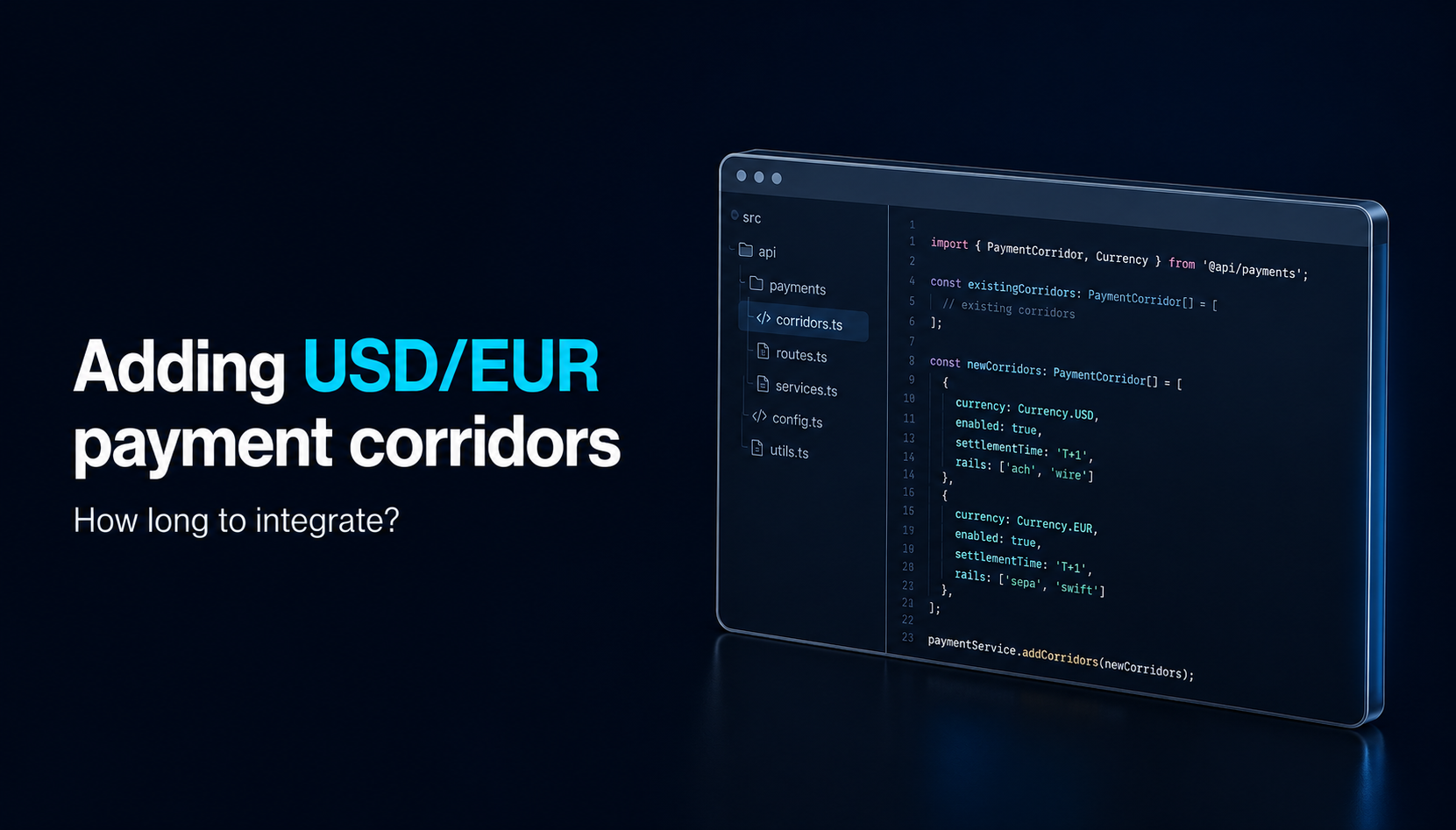
If you’re a CTO or Head of Product at an Argentine fintech, you’ve probably run this calculation already: how long would it actually take to launch this?
It’s not that no one offers USD or EUR rails into Argentina, several international providers do.
The friction is that covering ARS, USD, and EUR coherently, on top of Argentina’s CBU/CVU system, usually means stitching together two or three providers, each with its own integration, KYC process, and pre-funded account. The real choice isn’t build vs. one finished option: it’s assembling that patchwork yourself, or integrating a layer that’s already unified.
What building it in-house actually involves
“Build” usually gets scoped as a payments feature. In practice, it’s a small program:
- Establishing and testing banking or liquidity relationships for each currency (more than once if you want ARS, USD, and EUR together)
- Designing the account and custody model: how funds are held, segmented by client, and reconciled
- Building the compliance layer: KYB checks, transaction monitoring, audit trail
- Implementing operational controls: who can approve a transfer, who can see what, how withdrawals are limited
- Building monitoring and alerting so ops knows the state of every transaction, not just the failed ones
None of this is optional, and none of it ships in a sprint. It also competes directly with your existing roadmap: every week here is a week not spent on the product you were hired to build.
What integrating with B2B2X removes from that list
Authentication and access. OAuth2 client-credential flows with service accounts scoped to your organization: one machine-to-machine integration instead of negotiating banking access per corridor.
Account and custody structure. A master account plus sub-accounts model out of the box: the master account is your treasury, sub-accounts represent your clients or business units, each with its own balances and deposit addresses. This is the part teams most underestimate the cost of building themselves.
Access controls. Role-based access control, 4-eyes approval workflows, and address whitelisting are already built in (usually the piece that takes longest internally, since it requires security review, not just code).
Visibility. Webhooks on deposits, status changes, approvals, and balance updates, plus an immutable audit log (your monitoring and reconciliation layer, without owning the plumbing).
Pricing transparency. Quote and fee-estimation endpoints let you show the cost of an operation before it runs, useful if you’re pricing a corridor fee into your own product.
The real comparison
| Build in-house | Integrate with B2B2X | |
|---|---|---|
| Banking/liquidity relationships (per currency) | Establish and maintain each separately | Unified across ARS, USD, EUR |
| Account & custody model | Design and build it | Master + sub-account structure provided |
| Approval workflows & access control | Build and security-review it | RBAC, 4-eyes approvals, whitelisting included |
| Monitoring & audit trail | Build it | Webhooks + audit log included |
It’s not a philosophical build-vs-buy debate. It’s where you want engineering time to go for the next two quarters: stitching together corridor infrastructure, or the product you’re actually trying to differentiate.
Book a technical call to scope your corridor. Bring your architecture and your target timeline: we’ll tell you plainly what’s ready today, what’s on the roadmap, and what integration would actually take.