
What Comes After CVU: Connecting ARS, USD and EUR Without Rebuilding Your Stack
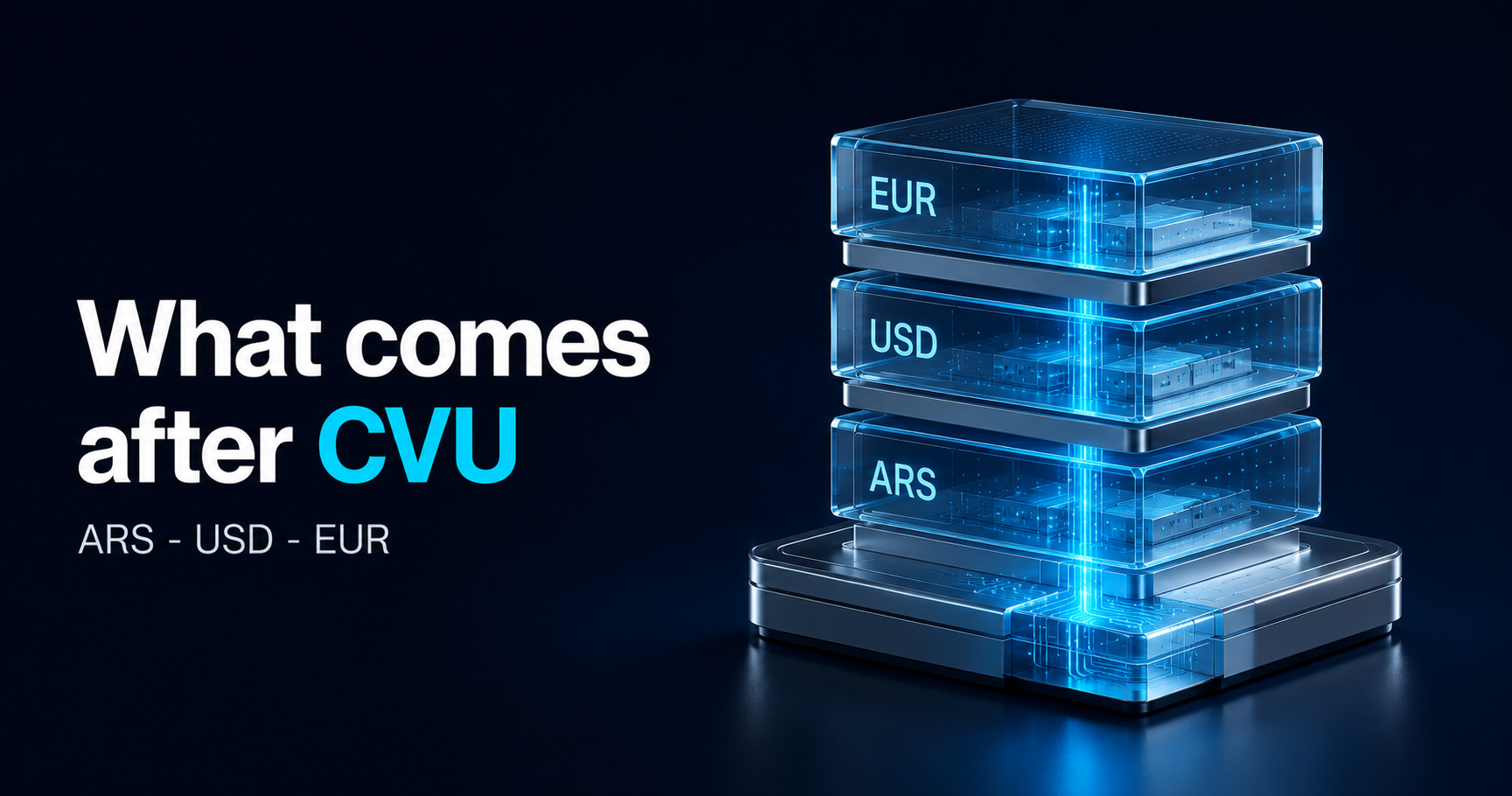
Your CVU integration was step one. That part works. The harder question is what comes next.
Most teams treat international currencies as a new project. It isn’t. It’s the same stack, stretched to do more.
CVU is the base layer, not the whole stack
CVU and CBU sit at the center of how Argentina moves money domestically. Instant bank-to-wallet and wallet-to-wallet transfers feel normal to users now, and that trust took years to build.
But CVU only covers the local layer. It has no corridor logic and was never meant to handle cross-border routing.
Once ARS works the way it should, the real question becomes how to connect that local layer to USD and EUR without building a second system next to the first one.
The problem is layering, not currencies
A lot of teams think adding USD or EUR means adding a new “foreign payments” product. It doesn’t. What actually needs to connect is three layers:
- Local rails, which move ARS.
- Cross-border routing, which moves USD and EUR.
- Settlement and reconciliation, which keeps both sides readable for finance and ops.
When these layers don’t talk to each other, the product works fine locally and breaks the moment money crosses a border. That’s usually when finance starts asking why the numbers don’t match.
How the stack should evolve
CVU isn’t something you replace. You extend the same logic that already works for ARS into the corridors your business actually needs.
| Layer | What it solves | What breaks if missing |
|---|---|---|
| CVU/CBU | Domestic ARS transfers and wallet interoperability | Local payments fragment |
| Cross-border routing | USD/EUR collection and payout corridors | International flows stay manual or bank-dependent |
| Orchestration | One product view across currencies and rails | Finance, ops, and product can’t reconcile |
The goal isn’t to stack rails for the sake of it. It’s to keep the whole thing coherent as currencies multiply.
Where the complexity actually hides
The hard part is rarely the “send” screen. It’s how the request gets routed, how the payment gets matched, how the ledger records the movement, and how balances stay in sync across currencies.
This is where teams overbuild, assuming every currency needs its own product when what they actually need is one layer that orchestrates multiple corridors inside a single architecture.
Where B2B2X fits and why that’s an architecture decision, not just a feature add
B2B2X doesn’t replace CVU. It’s the layer that lets you keep the strength of ARS rails while adding USD and EUR corridors, without standing up a new system every time a currency comes into play.
Concretely, this works because of how the account layer is built:
- a master account functions as your treasury;
- sub-accounts represent your clients or business units underneath it, each with its own balances and deposit addresses, but sitting on the same underlying structure regardless of currency.
Adding a corridor doesn’t mean provisioning a parallel account model; it means extending the same one. The same authentication (OAuth2 client-credential, service accounts scoped to your org), the same approval and access-control layer (RBAC, 4-eyes approvals, address whitelisting), and the same audit trail apply whether the flow is ARS, USD, or EUR.
That’s what “not rebuilding the stack” actually means at the architecture level: it’s not a slogan, it’s the account and control layer staying constant while the corridors on top of it change.
What teams usually miss here
Step one proved the local rail works. Step two is about not fragmenting what you just built.
The risk isn’t low volume. It’s ending up with three systems, one per currency, each drifting operationally in its own direction.
So the real question after CVU isn’t whether the local rail works. It already does. It’s whether your stack can absorb the next corridor without a rebuild.
Explore the B2B2X API documentation to see exactly how the account, authentication, and control layer stays the same across ARS, USD, and EUR corridors.