
How Argentine Agricultural Exporters Can Distribute Dividends to Shareholders Abroad
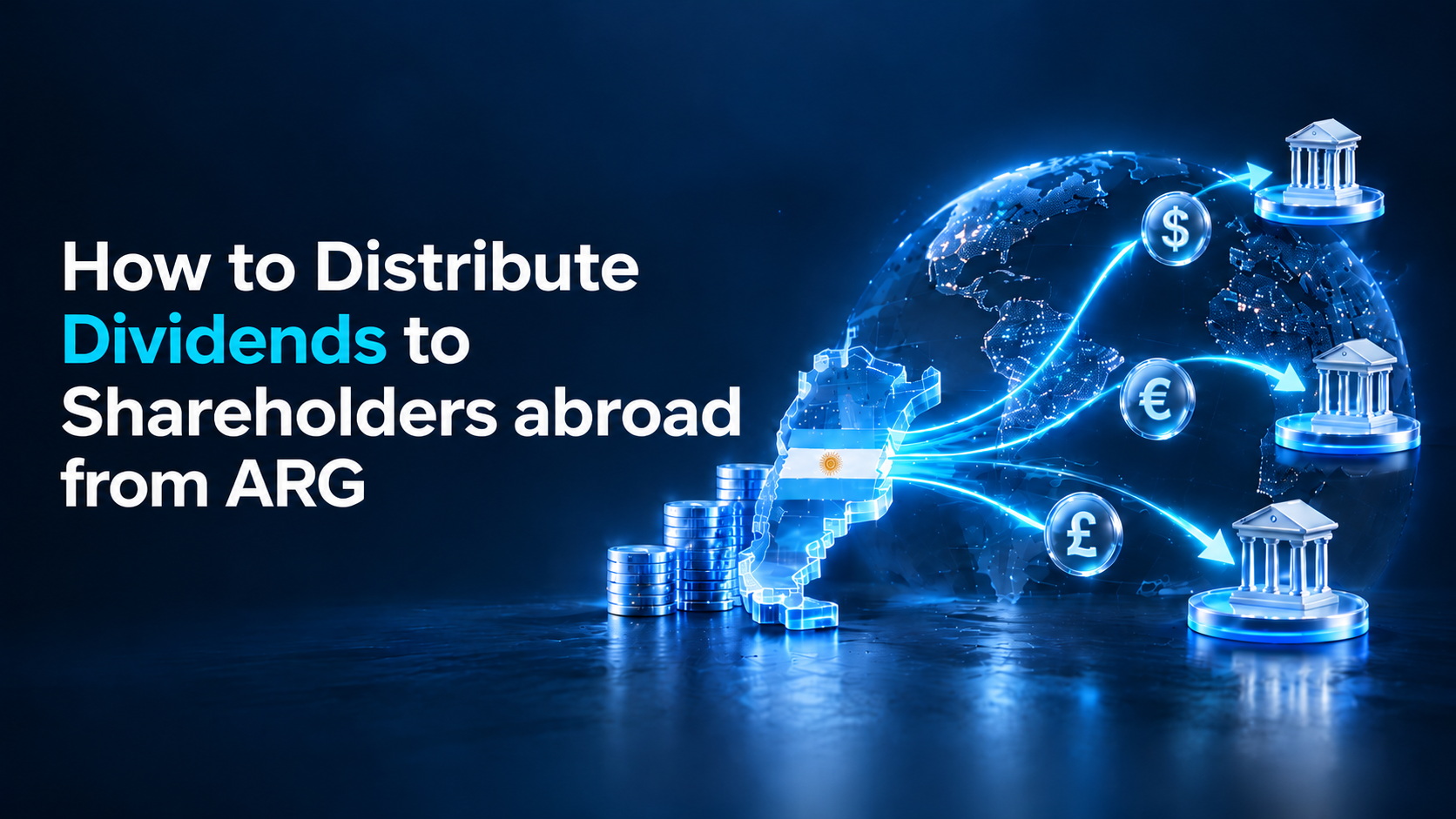
The dividends have already been approved. Now the company needs to get the funds to its shareholders.
For an Argentine agricultural exporter, that moment may coincide with supplier payments, logistics costs, taxes, crop-cycle expenses, and other demands that continue to draw on liquidity.
So before executing an international distribution, the company needs to answer a few practical questions: which funds can be set aside, which currency they should be held in, and how to organize payments to each shareholder without disrupting the rest of the treasury operation.
This article assumes that the dividend distribution has already been approved and that the company has completed the applicable corporate, tax, and foreign-exchange requirements. YouHodler does not replace those obligations.
One dividend distribution can turn into several separate payments
The corporate decision may be a single one. The execution often is not.
There may be several shareholders, different receiving accounts, and payments in USD or EUR. Some may require a currency conversion, while others may not.
Before releasing the funds, the company needs to know how much each shareholder is due, which currency they will receive, what FX rate and fees to expect, and whether any internal approval is still outstanding.
Once the funds are sent, the company also needs to be able to see what happened to each payment.
It is the same principle we explored in our article on international supplier payments: visibility matters both before and after the funds move.
Preparing liquidity without disrupting day-to-day operations
An agricultural exporter does not manage cash with shareholders alone in mind.
The same liquidity may also be needed for transport, suppliers, taxes, inputs, technology, or the next production cycle.
That is why, once a dividend distribution has been approved, it makes sense to identify and ring-fence the funds that can genuinely be allocated to shareholders.
If the approval date and payment date do not coincide, those funds can remain prepared until they are needed.
YouHodler allows eligible corporate balances to be managed in Digital Dollars or Digital Euros, depending on the products and flows available, and later used within supported distribution flows.
The goal is not to generate yield. It is to keep liquidity ready when its purpose has already been defined.
The same logic applies to the way companies manage excess ARS liquidity, with one key difference here: the future use of the funds is already known. They are earmarked for shareholders.
When the available currency does not match the payment currency
A dividend distribution may be approved in one currency while some shareholders expect to receive another.
In that case, FX becomes part of the distribution process.
The company should be able to review the expected exchange rate, fees, and estimated amount the recipient will receive before executing the payment.
That gives the company a clearer view of each payment upfront, rather than discovering the final cost only after the transaction has already been sent.
For an agricultural exporter that regularly operates across ARS, USD, and EUR, this visibility becomes especially important when several international obligations are competing for the same liquidity.
Where YouHodler fits in
YouHodler comes into the process once the applicable requirements have been completed and the dividend distribution is ready to be executed.
From there, the company can use the infrastructure to prepare liquidity, manage currency conversions where needed, execute payments within supported corridors and jurisdictions, and track their status afterwards.
Once payments have been made, being able to check their status and maintain a clear record of each transaction can also make reconciliation easier.
For an agricultural exporter, this is not a separate financial process sitting outside the business. It is another part of a treasury operation that already manages currencies, suppliers, international payments, and liquidity needs at different points in time.
Payment day should not be the day the preparation starts
By the time the distribution date arrives, the company should already know which funds it will use, how much each shareholder is due, and which currency each payment will be made in.
For an agricultural exporter operating across multiple currencies and markets, dividends are simply another international flow that requires planning and predictability.
The goal is to make sure an approved dividend distribution does not turn into a treasury problem just when it is time to pay.
Want to test how these flows work?
Explore B2B2X, YouHodler’s Business API, to test fund movements, conversions, payments, and transaction tracking in a sandbox environment.
You can assess how these capabilities could fit into the systems and processes your company already uses before moving to live operations.
Request access to the Beta Sandbox and start testing the API.